
I came across this post on Reddit from a plastic surgery clinic in Toronto:
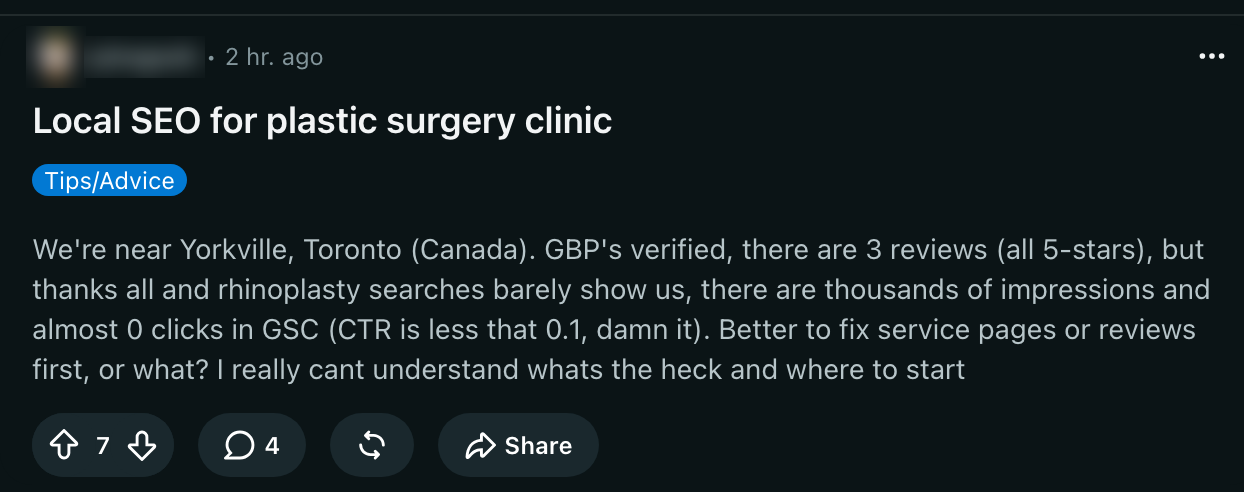
Verified Google Business Profile. Three 5-star reviews. Thousands of impressions in Search Console, and almost zero clicks. A CTR under 0.1%.
I haven’t seen their website. But I’ve seen this pattern hundreds of times. Those impressions are most likely coming from the Google Business Profile and the reviews. The website behind them probably isn’t set up properly: missing pages, thin content, nothing that gives Google a reason to send the click.
If you’re a business owner in the same spot, don’t make the same mistake. Here are 6 simple things to fix your organic lead engine.
1. Audit your website
You don’t need a massive technical audit. Just look at your site honestly:
- Is the user interface clean and easy to use?
- Are there broken sections or slow, heavy pages?
- Is anything messy or confusing?
- Does a visitor understand what you do, and why you, within a few seconds?
If your site fails any of these, fix it first. No amount of SEO will rescue a site people bounce off.
2. Fix your content structure
Build your site around a strong structure with clear target topics:
- A dedicated page for every service you offer, and every location you serve.
- Each service page aligned to its main keyword in the H1.
- Multiple subheadings on every page, all focused on that single topic.
- FAQs on every page.
One page trying to cover everything is one of the most common reasons local businesses get impressions but no clicks.
3. Go one layer deeper on content
Now audit the content you already have. Are the topics right? Is there room to make them better? Is any service page missing its main topic? If your FAQs are generic, make them hyper-local and personal. Do the same for every location page.
Find topics from real demand
Open your Search Console and Google Business Profile insights. Pick out the keywords that are already getting impressions. Then go to Reddit and Facebook groups on those topics and look at where people are interacting, sharing problems and arguing. Collect all of it and turn it into new content ideas.
Use those keywords to create blogs, silo pages and social content: YouTube Shorts, Instagram Reels, Facebook Reels and TikTok. Distribute the content across all of these channels.
Build a content planner
Create a Google Sheet listing your service pages and city pages. Then ask your AI tool to build a content planner for new supporting pages, like blogs or silo pages:
- 3 supporting posts for service 1
- 3 supporting posts for service 2
- …and so on for every service
If you have 5 service pages, that’s 15 new pages. Publish them in batches and link each one back to its main service page. Do the same for your location pages.
Note: don’t write a supporting post on the exact same topic as the service page itself. When two pages on your site are near-duplicates, Google picks one to show and filters out the other, and it may not pick the page you want. That’s what people call keyword cannibalization. Supporting posts should answer related questions and point back to the main page.
Track everything in the sheet so you always know which topics you’ve covered and how each one is performing. Do the same for your off-page content.
4. Watch Search Console, GBP insights and Semrush or Ahrefs
From here, you have two jobs:
- Keep publishing based on the content plan you built.
- Watch for keywords that drop, find the reason, and push them back up through the same content process until they’re climbing again.
5. Get serious about social media
Social media matters more now than ever. Create original content: stories, real photos and real videos of your work. The more you publish, the more material you give Google and AI tools like ChatGPT and Gemini to pull from and cite.
This month, one of our newer clients on our AI citation package started seeing it work: the Shorts and Reels we published for them began appearing in search results and Google AI Overviews. Many of our other clients show up in AI Overviews consistently, and the sources being cited are content we created, either on social media or in their silo pages.
So don’t underestimate social media.
6. Get as many reviews as you can
Google reviews are the best, but every review helps. Google and AI tools pull positive things people say about you from all over the web:
- Google reviews
- Facebook reviews
- Recommendations on other people’s websites
- Testimonial-style videos from your clients on social media
Reputation is the strongest pillar in your business. It brings customers back, and it brings new ones in.
Do all of it, consistently
None of this is a one-time fix. Audit, structure, go deeper, watch the data, show up on social and collect reviews, every single month.
If you’re a business owner and want help fixing your lead engine, send me a message. And if you’re an agency with clients of your own, check out our fully managed white-label SEO and AI citation packages.
We help home service businesses rank on Google Maps and show up in AI search. Agencies can resell all of it under their own brand.